
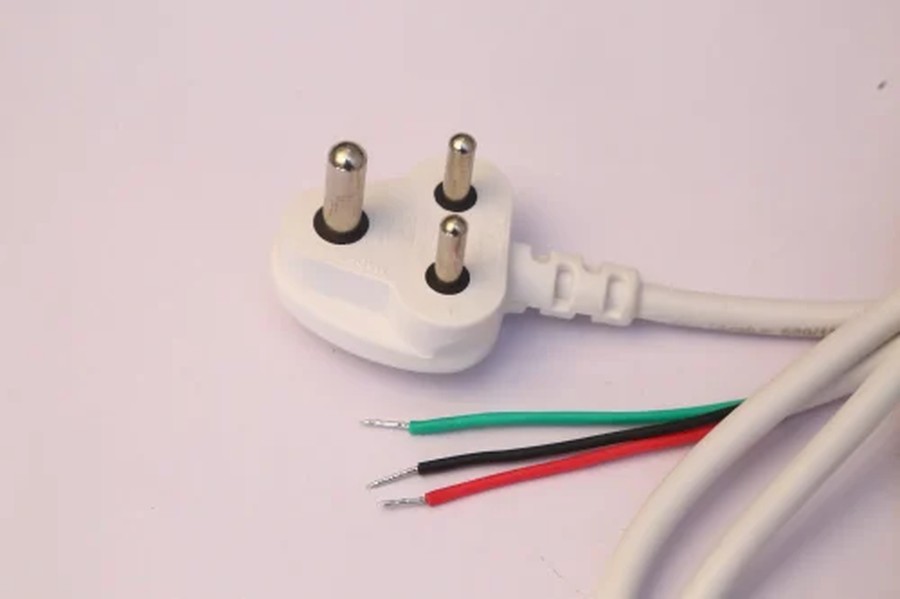
Walk through almost any older office or factory floor in India, and you will eventually spot it: a heavy-duty piece of equipment plugged into a wall using a violently altered plug. Someone physically snapped off the thick third earth pin just to force it into a smaller 2-pin socket. It is a terrifyingly common practice. When procurement teams evaluate which companies manufacture 2 pin and 3 pin power cords, they often treat the choice between the two formats as a matter of pricing or convenience, rather than a hard electrical boundary.
The misunderstanding usually starts at the procurement desk.
Buyers often assume a 2-pin cord is just a cheaper, sleeker alternative to a bulky 3-pin design. They think they can save a few rupees on a bulk order by dropping the earth wire. That is fundamentally incorrect. The difference is entirely dictated by the appliance’s internal architecture, specifically whether it is a Class I or Class II device under IS 1293 manufacturing standards.
If an appliance has an exposed metal chassis—like an industrial mixer, a commercial printer, or medical machinery—it legally requires a 3-pin plug. That long, thick top pin is the earth connection. It is quite literally the only safe path for errant current to escape into the ground if an internal live wire accidentally touches the metal casing.
According to recent National Crime Records Bureau (NCRB) safety data, electrical short circuits and electrocutions still account for nearly 8% of accidental deaths in India. Bypassing that earth pin directly contributes to those statistics.
We dealt with the aftermath of a severe near-miss incident at a commercial kitchen setup in Mumbai last monsoon. A contractor had tried to save a few thousand rupees by supplying ungrounded 2-pin cords for heavy, stainless-steel refrigerators. Predictably, an internal compressor fault leaked current straight to the metal door. The floor was wet. An employee grabbed the handle and took a massive 240V shock.
They survived. Barely.
But the resulting safety audit immediately shut down the entire kitchen operation for three weeks. The financial loss dwarfed whatever they saved on the cables.
You cannot compromise on the external tether and expect the machine or the operator to be safe. This rule applies inside the machine, too. The engineering teams deciding where Indian OEMs source their wire harnesses need to recognize that a perfectly routed, highly engineered internal wiring system is completely useless if the external power cord cannot safely discharge a grounding fault to the wall.
At Nisan Cords, we enforce strict design compliance for both formats. A 2-pin cord is perfectly safe, but only for double-insulated plastic appliances where the user can never touch a conductive surface—like a television or a hair dryer. For anything else, heavy-duty earthing is non-negotiable.
Stop letting casual convenience dictate your electrical safety. Make sure your team is actually specifying the right plug for the right machine, because a missing pin is never just a design choice. It is a life-safety hazard.